
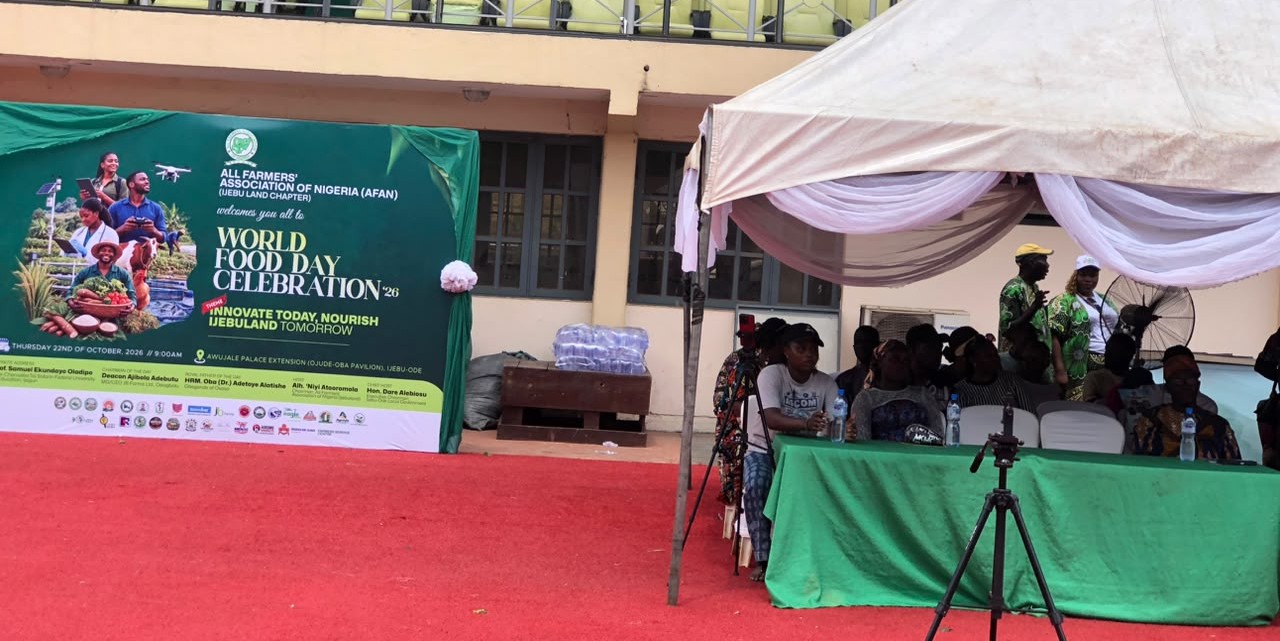
The Vice-Chancellor of Tai Solarin Federal University of Education (TASFUED), Professor Samuel Ekundayo Oladipo, has urged farmers in Ijebuland to become more involved in processing and adding value to their farm produce for better incomes, noting that they are often shortchanged by middlemen when they sell in raw form.
Professor Oladipo, represented by Professor Akinyode Olawumi, said this in a guest lecture delivered at the 2026 World Food Day programme organised by the All Farmers Association of Nigeria (AFAN) Ijebu Land Chapter, on Thursday, October 22, at the Awujale Palace Extension in Ijebu-Ode, Ogun State.
The World Food Day programme, themed “Innovate Today, Nourish Ijebu Land Tomorrow”, celebrated farmers across the six local government areas of Ijebu Land and their contributions to food security, nutrition and job creation.
The programme featured a guest lecture, keynote address, a food exhibition and sale of agricultural produce at discounted prices, display of agricultural machines and innovation equipment, and cultural performances, among others.
The event, which was attended by hundreds of farmers in Ijebu land under the umbrella of AFAN, attracted guests including the Special Adviser to the Ogun State Governor on Agriculture and Food Security, Angel Adelaja-Kuye; the Gbegande of Ososa, Oba Mojeed Adetoye Alatishe, represented by the Baale of Odo Aiye, Chief Adebayo Adetona Oluwo; and the Secretary to the Ijebu-Ode Local Government, Hon. Oke Abiodun Adebanjo.
Other guests include the AFAN Ogun State Chairperson, Alhaja Ganiyat Ibilola Kusimo; Secretary, Prince Abiodun Ogunjimi; Public Relations Officer, Johnson Shogunle; and the Youth Leader, Hon. Jamiu Adebukanla.
In the guest lecture, Prof. Akinyode Olawumi, a professor of Agricultural and Resource Economics at TASFUED, said value addition to farm produce helps to close the gap between harvest and consumption and create local jobs within the local food ecosystems.
He also called for better storage and cold room facilities to improve food preservation and reduce post-harvest food waste, saying such investment is needed to “preserve the quality of vulnerable value chains like tomatoes, dairy, and fresh vegetables before they spoil.”
Prof. Olawumi, the Director of the Institute of Vocational and Research in Agriculture, urged AFAN to regularly train smallholder cooperatives in “low-cost preservation methods such as solar drying, controlled fermentation, and specialised milling”, which he says “extends the shelf life of seasonal crops.”
He challenged AFAN in Ijebu Land and Ogun State to better coordinate farmers in cooperative groups to boost their negotiating power in the market and increase their chances of accessing credit facilities from commercial and agricultural banks.
Speaking on the theme “Innovate Today, Nourish Ijebu Land Tomorrow”, Prof. Olawumi highlighted four major goals and focus areas, namely: Agrifood Transformation by using science, digital tools, and local knowledge to fix broken food systems; Youth Empowerment and focus on young farmers and scientists as main drivers of change; Climate Resilience; and Inclusion by connecting small-scale producers with technology like mobile weather updates, disease diagnosis, detection and prevention and better market information and opportunities.
He said the theme of the World Food Day Programme should show how farmers can turn innovation into “better diets, stronger livelihoods, and a more resilient future.” He added that agricultural interventions in the local food systems must shift from “simply producing more calories to delivering sustainable, nutrient-dense value chains.”

Earlier in the welcome address, the Chairman of AFAN Ijebuland Chapter, Niyi Isiaq Atooromola, said the World Food Day programme speaks to the importance of food in “human survival, national development and global prosperity.”
He added that the event provided a platform for stakeholders to reflect and discuss the challenges facing food production, the importance of food security and the contributions of farmers to the national economy.
He said, “World Food Day is a significant occasion that provides an opportunity to renew our collective commitment to ensuring that everyone has access to sufficient, safe, nutritious, and affordable food. Food is not merely a necessity for survival; it is the foundation of a healthy society, a productive workforce, and a prosperous economy. Without food security, there can be no meaningful development, lasting peace, or sustainable progress.
“As farmers and agricultural stakeholders, we occupy a strategic position in achieving these goals. We are the producers of the food that sustains our families, communities, and nation. Our contribution to economic growth, employment generation, poverty reduction, and rural development cannot be overemphasised.”
Atooromola said the theme calls for urgent action in food production, support for farmers, developing agricultural systems to meet the nutrition needs of the people, and adopting modern methods and practices in agriculture.
He said, “The first part of the theme, “Nourish Today,” reminds us of the urgent need to strengthen food production, improve nutrition, reduce food waste, and ensure that our people have access to quality food. It calls on us to support our farmers, encourage local food production, promote healthy eating habits, and develop agricultural systems that can meet the food needs of our growing population.
“The second part of our theme, “Innovate Ijebuland Tomorrow,” challenges us to look beyond traditional methods and embrace innovation as a pathway to agricultural transformation. Agriculture today must go beyond the use of hoes and cutlasses. While we respect our traditional farming practices, we must also embrace modern technologies, improved seedlings, mechanisation, irrigation, climate-smart agriculture, effective storage facilities, food processing, digital agricultural services, and improved marketing systems.”
He, however, decried the several challenges confronting farmers and appealed to the federal, state and local governments, financial institutions and private sector stakeholders for increased funding, investment, research and support in the food and agriculture ecosystem.

He said, “Despite the enormous opportunities available in agriculture, we must acknowledge the challenges confronting our farmers. These include the high cost of farm inputs, inadequate access to affordable credit, limited mechanisation, poor storage and processing facilities, transportation difficulties, climate-related challenges, and the need for better access to reliable markets.
“These challenges require collective action. We need accessible agricultural financing, affordable fertilisers and improved seeds, modern farming equipment, functional extension services, irrigation infrastructure, processing facilities, and stronger market linkages.
“We also encourage public-private partnerships that will enable our farmers to benefit from new technologies, training opportunities, and investment in agricultural value chains.”
Niyi Atooromola expressed confidence that AFAN Ijebu land chapter “through unity, innovation, strategic partnerships, and sustained commitment” can provide food security and abundance in Ijebuland and ensure “a more productive, food-secure, and economically vibrant Ijebuland”.
He added, “Our vision must be to build an Ijebuland where farming is profitable, food is available and affordable, agricultural businesses thrive, young people see farming as a viable career, and our communities benefit from the wealth created by agriculture.”
Meanwhile, the Ijebu-Ode Legislative Council was well represented at the programme with the Leader of the House, Hon. Clement Sesan, the Deputy Leader, Hon. Adesina Ogundare and the Chief Whip, Gboyega Coker, in attendance.